Transforming Young Lives Through Early Intervention
01 Mar 2025
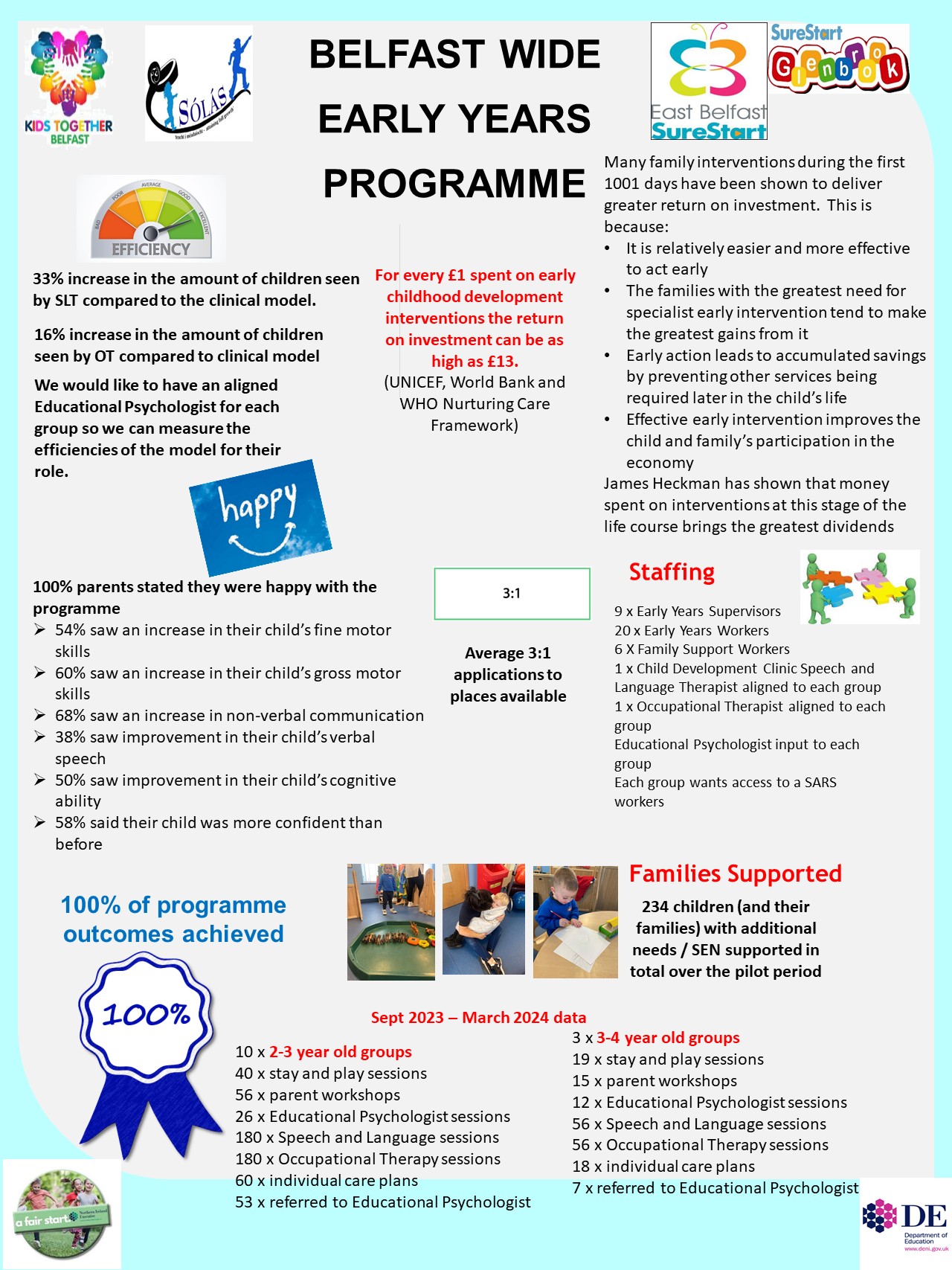
The Belfast Wide Early Years Intervention Programme (BWEY) began as a three-year pilot funded through the Department of Education’s Fair Start proposal, which focused on improving outcomes for children at risk of underachievement. Each year of the pilot was externally evaluated. This published summary relates specifically to Kids Together Belfast’s BWEY Rainbow Group, which supported 18 children aged 2-3 years and their families between September 2025 and March 2026. Children supported through the programme had additional needs, developmental needs and/or complex needs and many families were living in communities affected by poverty, deprivation and wider disadvantage. The evidence can therefore be understood in relation to a specific population group: children aged 2-3 years with additional or developmental needs and their families. The programme reflects evidence-informed early childhood practice through early identification, family support, structured routines, play-based developmental support, multidisciplinary input and transition planning. An infographic summarising the Belfast Wide Early Years evidence and partnership work is available to view on this webpage. The programme brings together early years practice, family support, Child Development Clinic Speech and Language Therapy, Occupational Therapy and Educational Psychology input. This joined-up approach enables children’s developmental needs to be identified earlier, families to receive practical advice and support and settings to plan more effectively for children’s next steps. The evidence published here reflects the information currently available from Kids Together Belfast’s BWEY Rainbow Group from September 2025 to March 2026. Emerging end-of-year information shows positive average progress across key developmental areas, including receptive communication, expressive communication, social interaction, play and attention, cognitive and perceptual skills, fine motor development, sensory development and self-care skills. These areas link directly to early childhood development, including children’s cognitive development, social and emotional development, communication, physical/fine motor development and independence. The model is designed to support children and families at the earliest possible stage, while also helping to inform transition planning for pre-school and nursery placements. Where appropriate, children may leave the programme with clear professional information to support a proposed statement of need for their pre-school nursery placement. Subject to funding and individual need, some children may also be able to progress into Kids Together Belfast’s EA Non-Statutory Specialist Nursery Provision, ensuring continuity of support for children who require a more specialist early years environment. Full 2025-2026 evaluation data from all participating groups is currently being collated. This will provide a fuller picture of the impact of the Belfast Wide Early Years Intervention Programme across the city. However, early information continues to demonstrate the value of a coordinated, relationship-based and developmentally informed model for children, parents and early years settings. Kids Together Belfast is committed to working in partnership to ensure that children with additional needs are identified, supported and included as early as possible, giving them the best foundation for learning, development and family life.
Source: Pamela Hughes


